It takes a while to get to the point here, but that's part of what makes it so fascinating. Take a look:
ADDED: Here's a pithy minute of response to the question:
ADDED: Here's a pithy minute of response to the question:


In addition to pushing the Justice Department to investigate civil rights charges against Zimmerman, Sharpton told supporters he wants to see a rollback of stand-your-ground self-defense laws now in place in more than 20 states.Zimmerman shot when he was pinned down and getting his head bashed into concrete. Stand-your-ground has to do with retreating when you can. Even aside from the fact laws can't ensure that bad things never, ever happen again — or else why is there murder? — stand-your-ground made no difference in Zimmerman's situation.
"We are trying to change laws so that this never, ever happens again," the Rev. Sharpton said.
Rosaline Wilson, 62, said she came to the rally remembering her 14-year old brother who she said was killed by a police officer several decades ago while he was riding home from school. Because of the experience, she said, Wilson was not surprised by the Zimmerman verdict, but thinks there is hope for the future.We need something concrete... Speaking of concrete, does anyone at these rallies mention that Martin bashed Zimmerman's head on the concrete?
"We need solutions; we need something concrete; we need change," she said.
After days of angry protests and mounting public pressure, President Obama summoned five of his closest advisers to the Oval Office on Thursday evening. It was time, he told them, for him to speak to the nation about the Trayvon Martin verdict, and he had a pretty good idea what he wanted to say.Summoned! So commanding. He talked to 5 advisers. We're not told who, but one of them
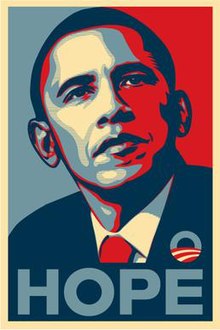
For the next 15 minutes, according to a senior aide, Mr. Obama spoke without interruption, laying out his message of why the not-guilty ruling had caused such pain among African-Americans, particularly young black men....So the man is capable of speaking spontaneously for 15 minutes straight, and his 5 companions — obviously 5 believers — refrained from interrupting him. It's not really that amazing to go on for 15 minutes, and we sayw him do that at the lectern on Friday, presumably because he convinced himself — with the support of the 5 — that talking, just like that, would take us to that higher level that was promised by those Hope posters.
[CONDOLE] ... First of all... I send my thoughts and prayers... to the family of Trayvon Martin....That's it: the 5 "cons." Don't even have to write it on your hand. Maybe in his head, he pictured one "con" superimposed on the face of each of the 5 believers he practiced with. Michelle was "confidence," all about the children and the hope, and so forth. That's just my sense of how he got through the 15 minutes, and he did it pretty well if you think about everything he had to pull together, all the people he needed to appease and inspire, and the theater of seeming to speak from the heart and the mind.
[CONTEXT] The second thing... a lot of arguments about the legal issues... But I did want to just talk a little bit about context and how people have responded to it and how people are feeling... in the African American community... a lot of pain... recognize that the African American community is looking at this issue through a set of experiences and a history that doesn’t go away.... those sets of experiences inform how the African American community interprets what happened one night in Florida.... black folks do interpret the reasons... in a historical context.... So folks understand the challenges that exist for African American boys.... they get frustrated, I think, if they feel that there’s no context for it and that context is being denied....
[CONVENE] Now... How do we learn some lessons from this and move in a positive direction?.. I'm not naïve about the prospects of some grand, new federal program. I'm not sure that that’s what we're talking about here. But I do recognize that as President, I've got some convening power, and there are a lot of good programs that are being done across the country on this front. And for us to be able to gather together business leaders and local elected officials and clergy and celebrities and athletes, and figure out how are we doing a better job helping young African American men feel that they're a full part of this society and that they've got pathways and avenues to succeed....
[CONVERSE] And then, finally... There has been talk about should we convene a conversation on race. I haven't seen that be particularly productive when politicians try to organize conversations. They end up being stilted and politicized, and folks are locked into the positions they already have. On the other hand... That would, I think, be an appropriate exercise...
[CONFIDENCE] And let me just leave you with a final thought... Each successive generation seems to be making progress... we should... have confidence that kids these days... have more sense...
I hope not because our laws do not allow such conduct. It is not illegal for a private citizen to follow someone. It is illegal to physically assault another person who has not threatened him with the imminent use of force.
I am very disappointed that the President has chosen to endorse those who have turned a case of assault and self-defense into a referendum on race and civil rights. And that he is using it to support those with an agenda of restricting gun rights.
“You know, when Trayvon Martin was first shot, I said that this could have been my son... Another way of saying that is Trayvon Martin could have been me 35 years ago.”These are memorable but empty statements. Fill them with whatever you want. This isn't a critique of the legal system and how it handled the case. It's a vague claim of authority to empathize.
“I don’t want to exaggerate this, but..."But! Have it both ways. I don't want to exaggerate, but I've just got to say it anyway.
"... those sets of experiences inform how the African-American community interprets what happened one night in Florida. And it’s inescapable for people to bring those experiences to bear.”That's utterly banal: People understand things within the context of their own experiences.
“I think it would be useful for us to examine some state and local laws to see if it — if they are designed in such a way that they may encourage the kinds of altercations and confrontations and tragedies that we saw in the Florida case, rather than diffuse potential altercations”...Useful to examine the laws... okay.... He's really not saying anything, and yet the New York Times must sum up by giving him credit:
Mr. Obama spoke in deeply personal terms — an extraordinary moment for a president who seemed, at least during first term, often to shy away from the issue of race.What is deep and extraordinary? The case was already racialized, and he resonated with a bit of that without saying too much.

MORGAN: You felt that there was no doubt in your mind from what Trayvon was telling you on the phone about the creepy ass cracka and so on, that he absolutely believed that George Zimmerman, this man, you didn't know who he was at the time, but this man, was pursuing him?Here's my post from June 27th, with embedded video from Jeantel's testimony. I said (boldface added):
JEANTEL: Yes.
MORGAN: And he was freaked out by it?
JEANTEL: Yes. Definitely after I say may be a rapist, for every boy, for every man, every -- who's not that kind of way, seeing a grown man following them, would they be creep out?... And people need to understand, he didn't want that creepy ass cracker going to his father or girlfriend's house to go get -- mind you, his little brother was there. You know -- now, mind you, I told you -- I told Trayvon it might have been a rapist."
You assume that there's no way he'd say "cracker" if he didn't see him as white? But he didn't say "cracker." He said "creepy ass cracker." I understand the use of "ass" as an intensifier connected to the adjective "creepy." Creepy-ass cracker, as in very creepy cracker.Call out the gay rights activists. In this interpretation, it was a gay-bashing!
But "ass" could go with "cracker" — "ass-cracker." The conversation continued, according to Jeantel: "So... he told me the man was looking at him, so I had to think it might have been a rapist."
Why rapist? A man raping a man? How common is that as a fear? But it was the first thing Jeantel thought to say after he said creepy-ass cracker/creepy ass-cracker. The term "ass cracker" could easily mean a man who rapes a man, especially one who goes after a teenaged boy....
The word "creepy" makes special sense if you reinterpret the "ass" to go with "cracker." Martin said a man was following him, looking at him. He might have thought Zimmerman was a man out looking for sex and was watching him for that reason. What conversations had Martin had in the past with Jeantel about worries of this kind. She "had to think it might have been a rapist."...
Why didn't Martin take Jeantel's advice and run home? The rapist/ass-cracker theory makes sense of Martin's decision to go after Zimmerman. If he saw Zimmerman as a sexual predator, he might think confrontation was a good idea or even an important step: These creeps in the neighborhood need to know that I'm not their prey. It's not enough to run inside daddy's house. My manhood must be established here and now or I can't walk free around here anymore.
If the public wants to... believe them, that's their right. If they want to bring civil lawsuits against George Zimmerman or law enforcement or public entities, that's their choice. But when it comes to those lawyers and their public relations team using their bully pulpit to inflame passions and exert undue influence on the actions of law enforcement and public officials, including elected prosecutors, who have a duty not to bring charges without a good faith belief they can prove those charges beyond a reasonable doubt, all the while having a financial stake in the outcome of related civil litigation, I object.Much more at the link.
Following the verdict, with rallies and protests being held across the nation, and the NAACP and Al Sharpton vowing to take matters further, the President might be expected to remind the nation of the importance of the rule of law and respect for the judicial process....
But as of early Sunday morning, with the country on edge, the White House had yet to issue any statement.1. Is the country really "on edge"? Ironically, saying that is fanning the flames of outrage and division. How about waiting to see some sign of this edginess before expecting the President to advise calm?
This must be in the AP stylebook somewhere, because that sentence, or some variation therof, is found in every single article about the case: Martin "is" black but Zimmerman only "identifies" as Hispanic. Can you recall any other situation in which AP has played with racial identification vs. race as a fact in the news story?This is a great topic about which to maintain vigilance.
Prosecutors counter that Mr. Zimmerman, whose mother is Peruvian, set out to confront Mr. Martin and initiated the fight that ended in Mr. Martin’s death.Instead of the umbrella category "Hispanic," we get the specification of the country of origin, in this instance, Peru. So "Hispanic" dissipates into numerous subgroups that are actually more real and more factual. I've seen a lot of discussion lately about that. (Google "There's no such thing as Hispanic" to get a taste.) And I think this is a trend that will increase along with the size of the Hispanic voting bloc. The subgroups will matter more, and the subgroups are more real.
But in the courtroom where George Zimmerman is on trial for second-degree murder, race lingers awkwardly on the sidelines, scarcely mentioned but impossible to ignore.What does that look like — race lingering awkwardly and impossible to ignore?
For African-Americans here and across the country, the killing of Mr. Martin, 17, black and unarmed, was resonant with a back story steeped in layers of American history and the abiding conviction that justice serves only some of the people.Seeing one event steeping in layers of history and within the context of abiding convictions is the very mechanism of prejudice. But the NYT is, apparently, sorry the trial isn't a festival of prejudicial thinking! How to write that up into an article? Call in the sociologist:
“For members of the African-American community, it’s a here-we-go-again moment,” said JeffriAnne Wilder, an assistant professor of sociology at the University of North Florida. “We want to get away from these things, but this did not happen in a vacuum. It happened against the backdrop of all the other things that have happened before.”It's not awkward to shunt the backdrop of all the other things that have happened before to the sidelines during a trial. Rather, it's precisely what the judge and lawyers and jurors are required to do.
Yet inside a Seminole County courtroom, with the prosecution’s case against Mr. Zimmerman now over, race only occasionally punctuated the proceedings.Yet?! No! Race should not be put where it isn't relevant under the rules of evidence. Punctuation like that would violate the norms of a criminal trial. The backdrop of all the other things that have happened before is reason for Americans — especially black Americans — to care about these norms.
For supporters of the Martin family, Mr. Martin’s death was part of a more complex tale of profiling and injustice.But trials are not to be transformed into a "more complex tale." They are to be kept focused on the specific incident under consideration. And those who care about the more complex tale ought see the connection between their concern and the law's insistence on that focus.
... The charge is second-degree murder, inflicting death with spite, hatred or ill will. But no one in the courtroom is saying outright that race or racial hatred entered into the shooting.They're not saying it outright because witnesses have to testify about what they actually heard and saw on this occasion. It's not as if something is being suppressed and hidden. Talking only about the evidence is the way to shed light and bring clarity to the task of deciding what happened.
In the cocoon of the courthouse, even Mr. Martin’s bullet-scarred hooded sweatshirt, positioned for jurors in a clear plastic frame, appeared less a poignant symbol for the thousands who marched in his name than a lamentable but necessary piece of evidence.For the NYT, the courtroom is a "cocoon," and somehow reality resides in the minds of the throngs who feel the poignancy.
Still, black pastors, sociologists and community leaders said in interviews that they feared that Mr. Martin’s death would be a story of justice denied, an all-too common insult that to them places Trayvon Martin’s name next to those of Rodney King, Amadou Diallo and other black men who were abused, beaten or killed by police officers.This suggests that Zimmerman should be convicted because of the poignant feelings about all these other people.
“[Rachel Jeantel] was mammyfied,” said Ms. Wilder, the sociology professor, expressing disappointment over the reaction. “She has this riveting testimony, then she became, overnight, the teenage mammy: for not being smart and using these racial slurs and not being the best witness. A lot of people in the African-American community came out against her.”I guess I need to look up the race-studies technical term "mammyfied." I don't remember Mammy — in "Gone With The Wind," for example — being dumb.* Interesting that it's the sociology professor promoting the use of stereotypes. We should be rising above the stereotypes and treating people as individuals, and trials are designed to do that. This resistance to the workings of the criminal trial are truly deplorable, and it almost seems intended to exacerbate the terribly sad feelings of grievance that come from the larger historical context. Fair trials should be understood as a remedy for all the other things that have happened before. To present the fair trial as additional wounding is truly execrable.


